

15 SEP 2026 · FROM STRASBOURG
EU officials react to Romania's election annulment
At a Strasbourg press conference on foreign interference, EP President Roberta Metsola and special committee chair Nathalie Loiseau discussed lessons from Romania's annulled election — driven by roughly 170,000 fake TikTok accounts — and what the EU owes candidate countries like Moldova.
Romania's unprecedented annulment of its presidential election — driven by mass manipulation of public opinion through roughly 170,000 fake TikTok accounts and the involvement of foreign state actors — continues to send shockwaves through the European Union. The event has turned Romania into a major reference point for how vulnerable the EU's digital space is to hybrid warfare.
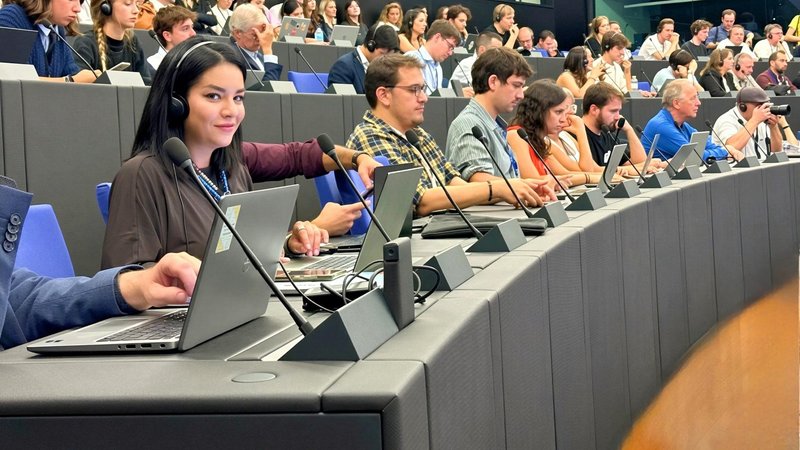
The subject was extensively debated at a European Parliament press conference, where senior MEPs presented the conclusions of the special committees, the measures needed to protect future elections, and the security challenges in the EU's eastern neighbourhood.
Roberta Metsola (President of the European Parliament) — on lessons from the rule-of-law mechanism, preparing for 2029, and support for Moldova:
"Maybe to also answer the previous question — when this Parliament insisted almost ten years ago that a rule-of-law mechanism should exist, there were questions. What would the role of such a mechanism be? What is its legal form? Are there competences at European level? And what we've learned, especially now, almost a decade later, from the experience of this mechanism and the work done by our colleagues in this Parliament, together with then-Commissioner Jourová and now Commissioner McGrath, is that exchanging information between one member state and another — recognising that member states go through similar experiences, and that resources can be used for common goals — works, regardless of whether it has, I'd say, a solid legal basis of competence or not.
And that's what the Centre could look at in terms of preparedness. We talk a lot about being prepared from a security perspective against hybrid threats. Are we prepared when it comes to cyberattacks? Are we prepared enough to fight disinformation, propaganda, bots, fake profiles designed purely to manipulate election results? And that's something we've pushed for in this Parliament. You saw today, with the majority, that there is genuine will — and that's why we expect action, because the Commission would have an overview of what's happening in every election, so that we're ready for 2029.
With Moldova, in everything we do — and this is a Parliament that has been extremely open to making sure we bring the Moldovans in, both in terms of a very, very strong delegation looking at what's happening in Moldova, in terms of helping with cybersecurity, election monitoring... And I have to thank the President of the Republic of Moldova and her government for pushing back and making sure that we, whether we're talking about local elections, parliamentary elections, or the upcoming presidential election — this is a candidate country with a lot of experience, but we also need to help with our structures, with our democratic way of helping, whether it's Parliament to Parliament, but also with the funding needed to have elections that are as independent as possible. And that's the least we should expect."
Nathalie Loiseau (MEP) — on citizens' own mindset, rules for candidate countries, and European Commission transparency:
"Maybe on both issues, Moldova and Romania... and more broadly, candidate countries. I think we have a duty to support democracy and fight interference. We have a civilian mission in Moldova, and now one in Armenia too, to support the authorities fighting interference and to expose the reality of that interference — because ultimately, it isn't the European Union or national states that stop interference. It's the mindset of citizens themselves. The moment they know interference exists, they can exercise their own independence in how they form their opinions and decide their country's future. That's part of it.
We should also think about an accession process that candidate countries could benefit from from the very start — from our own rules, like the Digital Services Act [DSA], because I can imagine what it means for a small country like Moldova to have a conversation with Big Tech when the country is that small.
And coming back to Romania and other examples of what may have happened in the past, or what could happen now or in the future — if the Commission has a dialogue with platforms, and it does, it has to become public. Along with the results of inquiries and investigations. It can't be a discussion between private companies and technocrats, bureaucrats in Brussels. If the Commission knows about certain algorithm changes, or about inauthentic behaviour that platforms haven't mitigated, that has to be shared with the wider public and with this House. Democracy, in other words, starts with bureaucrats sharing what they know about the fights against democracy and against our own independence.
If there were a food-safety scandal in Europe, the European Commission would make it public in the first minute, so people wouldn't be poisoned, or so democracy wouldn't be poisoned. And the European Commission has to make public what it knows."